
Anderson County Arrest Records and Court Charges
Arrest records in Anderson County are tied to the law enforcement and booking side of a case. The Anderson County Sheriff's Office handles local custody questions at 135 East 5th Avenue in Garnett and is the documented phone channel for current jail or booking information. The official county sources do not publish an Anderson County mugshot database or public jail roster, so an arrest lookup should not start with an assumed booking website.
Court charge records are narrower and more formal. They show what the Anderson County Attorney or law enforcement complaint places before the District Court after an arrest or citation. A charge record may list the count, statute, offense text, severity level, arresting agency, bond, next court date, and status for each count. The full case file adds motions, pleas, sentencing, probation, restitution, costs, and later expungement orders, so a filed charge is not the same thing as a final criminal judgment.
The Anderson County Sheriff's Office page is the local source for sheriff contact details and custody routing. Use it for the booking side of Anderson County arrest records, then use court sources for the charges filed after arrest.
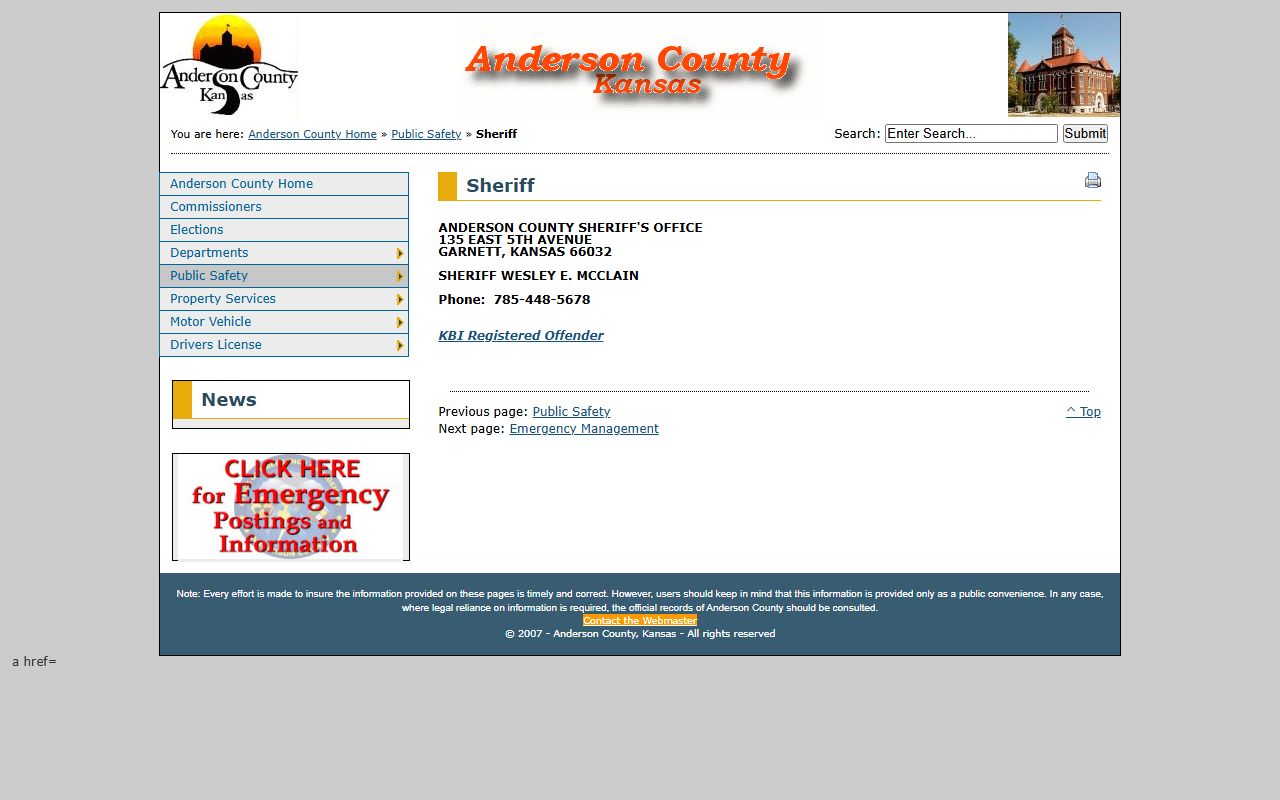
The sheriff source supports the local custody channel, but it does not publish a searchable Anderson County booking database.
Anderson County Charges After Arrest
Anderson County does not use a local office titled district attorney. The official prosecutor source is the Anderson County Attorney's Office. The office names Steven R. Wilson as County Attorney and Wade H. Bowie II as Assistant County Attorney, and the county page says the office prosecutes criminal, traffic, and juvenile cases arising in Anderson County. That role matters because charges after arrest are not just a copy of the booking allegation. The prosecutor decides what charge, count, or amended charge is filed in court.
After an arrest by the sheriff, Garnett Police, Kansas Highway Patrol, or another agency, the person may be taken through intake at the local jail. Intake may include identity checks, fingerprints, a photo, property intake, and warrant or hold review. The charging decision follows on the court side. For state cases, the County Attorney reviews the facts and files or prosecutes the case in Anderson County District Court. Some city ordinance and city traffic matters may remain with Garnett Municipal Court instead.
The official Anderson County Attorney page identifies the local prosecution office and its criminal, traffic, juvenile, Child in Need of Care, involuntary commitment, and county code duties.
The KBI Registered Offender Website is a separate public registry source, not a booking or court charge database.
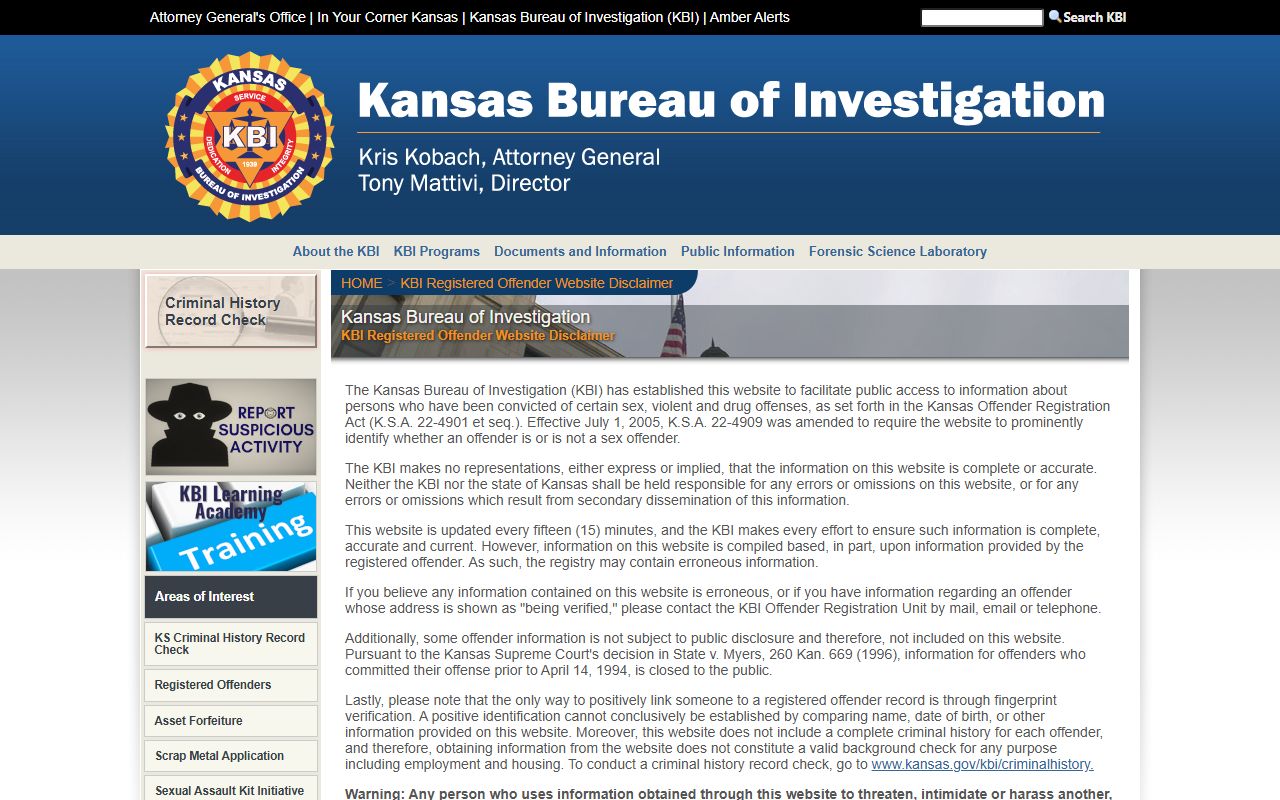
Registry and criminal history tools can add context, but the charge filed in court must be checked against the actual court case record.
Anderson County Charging Documents
A charge record starts with a charging document. In a Kansas criminal case, the public case file may show a complaint or other charging paper, then later docket entries for hearings, bond, plea, disposition, sentence, and payment issues. The exact public document image may not be available online, even when case information is searchable. For documents, older files, certified copies, and sealed-status questions, the local custodian is Tina Miller, Clerk of the District Court at Anderson County Courthouse.
| Complaint | Information | Indictment | |
|---|---|---|---|
| Filed By | Law enforcement or prosecutor, depending on the case path | Prosecutor | Grand jury process, when used |
| Common Use | Initial criminal charge or citation-based case | Formal prosecutor charging paper | Serious or grand jury matters |
| Record Value | Shows the first filed allegation | Shows the prosecutor's filed counts | Shows charges returned through grand jury action |
One arrest can lead to no filed charge, one filed count, or several separate counts. It can also lead to a reduced or amended charge later. That is why the court charge record should be read count by count instead of treated as a single label for the arrest.
Anderson County Charge Record Fields
Anderson County District Court records follow the Kansas district court record path. A public case entry may show case number, county, case type, parties, filing date, judge, status, future hearings, docket entries, financial obligations, and public disposition details. For charges, the most important fields are the count number, statute or offense text, severity level, bond, hearing date, and disposition for each count.
| Field | What It Shows |
|---|---|
| Count Number | Separates each allegation filed after the arrest or citation. |
| Offense Description | The charge name or short statement of the alleged crime. |
| Statute or Code | The Kansas statute, ordinance, or cited legal authority when public. |
| Severity Level | Whether the charge is felony, misdemeanor, traffic, juvenile offender, or another case type. |
| Bond | Money or conditions tied to release and future appearance. |
| Disposition | The final result of that count, such as guilty plea, dismissal, acquittal, or other order. |
Charge fields may be redacted or missing from public search results if the case is sealed, expunged, juvenile, or otherwise restricted. A public search result is also not a certified copy. The Clerk of the District Court is the proper route for official copies.
Search Anderson County Filed Charges
The primary online court path is Kansas Case Search. The Kansas Judicial Branch states that district court case information and case records can be searched online or at courthouse terminals. If the online result is incomplete, a courthouse terminal at Anderson County Courthouse or direct clerk contact may be needed. For city traffic or ordinance matters, Garnett Municipal Court may be the starting court instead of the district court portal.
- Identify whether the matter is an Anderson County District Court case or a Garnett Municipal Court matter.
- Search by case number when known. If not, search by defendant name and filter by Anderson County if the portal offers that field.
- Open the case entry and review each charge count, hearing, bond entry, and disposition line.
- Use the courthouse terminal or Clerk of the District Court for documents, certified copies, old files, or restricted-status questions.
Note: Portal field labels can change, so verify the live Kansas Case Search screen before relying on a narrow search instruction.
Anderson County Charge Status
Charges can change after filing. A pending charge is still active. A dismissed charge ended without a conviction on that count. An amended or reduced charge means the filed allegation was changed by prosecutor action, plea negotiation, court order, or other case event. A nolle prosequi entry, if used in the record, means the prosecution did not continue that count. Always read the docket date and the final disposition together.
| Status | What It Means |
|---|---|
| Pending | The charge remains open and awaits hearing, plea, trial, or other court action. |
| Amended / Reduced | The original count changed, often to a different charge, level, or wording. |
| Dismissed | The count was ended by court order or prosecutor action without a conviction on that count. |
| Nolle Prosequi | The prosecution chose not to proceed on the charge, if that wording appears in the record. |
Bond and warrant entries can appear beside charge activity. A failure to appear may create a bench warrant even when the underlying charge is minor, and a bond amount can change after later court events.
Anderson County Charges vs Convictions
A charge is an accusation filed with the court. A conviction is the result of a guilty plea, no-contest plea accepted by the court, or guilty finding after trial. Anderson County arrest records and court charge records can show allegations that never became convictions. For employment, housing, licensing, or other regulated screening, a court lookup should not be used as a consumer report.
| Charge | Conviction | |
|---|---|---|
| Stage | Filed allegation after arrest or citation | Final guilty result by plea or verdict |
| Proof Level | Starts from probable cause or prosecutor filing decision | Requires proof beyond a reasonable doubt or valid plea |
| Record Meaning | Does not prove guilt | Shows legal guilt on that count |
| Where to Confirm | Complaint, charge list, docket entries | Disposition, journal entry, sentencing order |
Important: Court charge lookups are not FCRA consumer reports and may not be used for FCRA-regulated decisions.
Anderson County Criminal History Checks
Statewide tools serve different jobs. The KBI criminal history record search is a Kansas.gov purchase search with a $30 price and daily availability except midnight to 4:00 a.m. Central. It is not the same as the Anderson County District Court file. The court file shows local case events and documents, while KBI criminal history is a statewide repository search.
The KDOC KASPER disclaimer covers state prison and supervision data, not local pretrial jail booking. The KDOC source says offender location and status are updated each working day, and a status can change between updates.
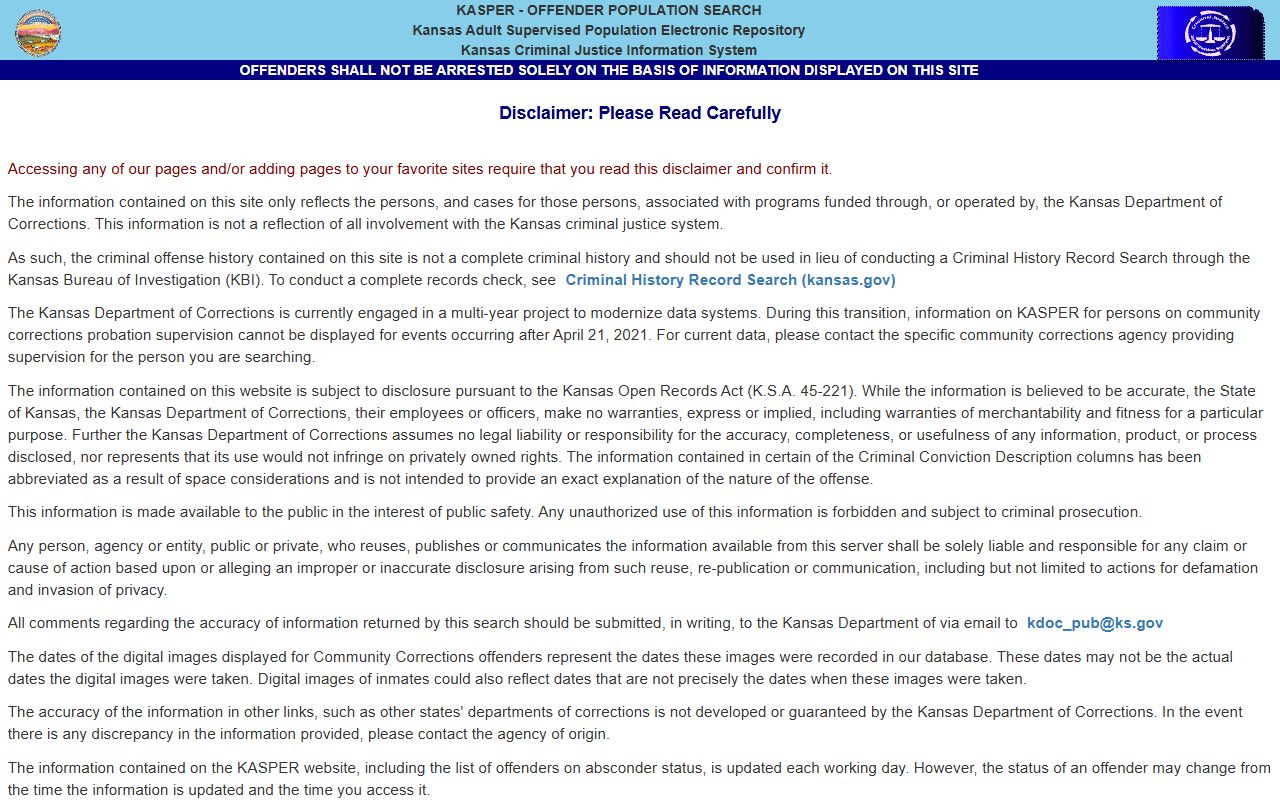
KASPER may help after a person moves into state correctional custody, but it is not a substitute for Anderson County filed charge records.
The KDOC resident locator page is another state custody source for people already in state custody.

Use state custody tools only after checking whether the case is still local, pending, municipal, dismissed, or otherwise not in KDOC custody.
Restricted Anderson County Charge Records
Kansas public access is broad but not absolute. K.S.A. 45-216 states the policy that public records are open unless otherwise provided by law. K.S.A. 45-221 lists records that need not be disclosed and supports separating open from closed information. Juvenile official files are controlled by K.S.A. 38-2309, so juvenile charge records should not be treated as freely searchable.
Expungement can also limit public access. Kansas Self-Help says arrest records, criminal convictions, and juvenile adjudications may be expunged when allowed by law. KBI materials reference different statutes for convictions, arrest records, diversion agreements, juvenile matters, and wrongful-conviction contexts. An expunged record may vanish from ordinary public search or show only limited information, while courts, law enforcement, licensing agencies, or other authorized users may still have allowed access.
The KDOC contacts page is useful only for state correctional record routing, not for changing an Anderson County court charge.

For local sealing, certified-copy, or expungement status questions, the Anderson County District Court record remains the controlling source.