
Anderson County Criminal Court Files
A criminal court record is the court file kept after a prosecutor files a case. In Anderson County, the local prosecutor is the Anderson County Attorney, not a district attorney. The official county attorney page names Steven R. Wilson as County Attorney and Wade H. Bowie II as Assistant County Attorney, and it states that the office prosecutes criminal, traffic, juvenile, Child in Need of Care, involuntary commitment, and county code violation cases arising in Anderson County.
The District Court is the key trial court for Anderson County criminal case files. Kansas district courts have general original jurisdiction over civil and criminal cases, and K.S.A. 20-301 establishes a district court in each county as a court of record. Garnett Municipal Court is a separate city court for city ordinance violations and city traffic matters. Municipal cases can have court dates and payment records, but the full felony and most state criminal case records belong in District Court.
The local prosecution source is the official Anderson County Attorney page.
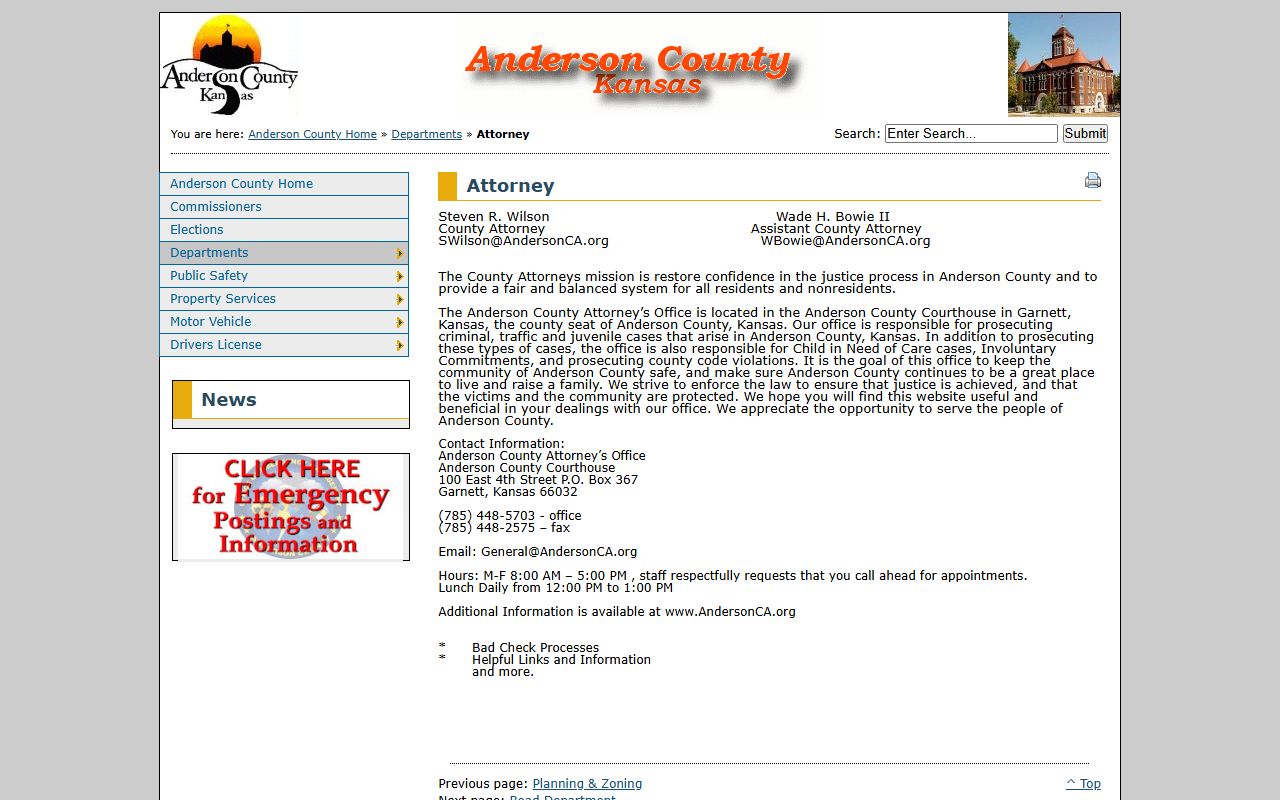
This local source anchors the criminal case file discussion because it identifies the office responsible for prosecuting criminal charges in the county.
Search Anderson County Criminal Records
Use Kansas Case Search for public district court case information. Search by case number when possible. If the case number is unknown, search by defendant name and narrow by Anderson County or court location when that option is available. Kansas Case Search may show public case information, docket entries, hearings, disposition, and other summary fields, but full documents, older files, certified copies, and restricted records may require the Clerk of the District Court.
- Confirm that the matter is a District Court criminal case rather than a Garnett Municipal Court citation.
- Search Kansas Case Search by case number, or by defendant name when the case number is not known.
- Review the case type, court location, filing date, status, parties, and judge to confirm the match.
- Open the docket entries to read hearings, motions, warrants, disposition, and sentence entries.
- Request certified copies from Tina Miller, Clerk of the District Court, when proof of an order or disposition is needed.
The Kansas Self-Help criminal and traffic law resource is available through Kansas criminal and traffic law help.
That statewide help source supports the search process because criminal case records often connect to pleas, diversion, court appointed counsel, ticket payment, and driver license issues.
Anderson County Criminal Case Flow
A criminal court file grows as the case moves from accusation to final result. Arrest and booking may occur first, but the court record becomes the main public case file after charges are filed. The Anderson County Attorney prosecutes the case, the court sets hearings, the clerk records filings and orders, and the judge handles pleas, motions, trial settings, disposition, and sentencing. For a narrower look at the allegations themselves, use Anderson County court charge records.
Case flow: Charges Filed › First Appearance › Arraignment › Pretrial / Motions › Plea or Trial › Disposition › Sentencing › Probation, Costs, or Post-Judgment Entries
| Stage | What Happens | How It May Appear |
|---|---|---|
| Charges Filed | The prosecutor or complaint starts the criminal case. | Complaint, count list, statute, case number, filing date. |
| First Appearance | The defendant is advised of the case and conditions. | Bond, counsel status, next hearing, release conditions. |
| Arraignment | Charges are addressed and a plea is entered. | Plea entry, hearing minute, future setting. |
| Pretrial / Motions | Parties file motions, seek orders, exchange issues, or ask for continuances. | Motions, orders, notices, continuances, hearing entries. |
| Plea or Trial | The case resolves by plea, trial verdict, dismissal, or other court action. | Verdict, plea, dismissal, amended charge, disposition. |
| Sentencing | The court imposes jail, prison, probation, costs, restitution, or other terms if conviction occurs. | Sentence entry, probation terms, financial obligations, restitution. |
Anderson County Criminal Record Fields
Criminal court records in Anderson County can show both the charge history and the case outcome. The record may list the original charge, an amended charge, a dismissed count, a plea, a verdict, a sentence, probation, restitution, costs, bond, warrants, and revocation proceedings. A person should read the disposition of each count rather than assume every filed charge ended in conviction.
| Field | What It Shows |
|---|---|
| Case Number | The Kansas district court identifier for the criminal case. |
| Defendant | The person charged in the case, listed in the caption with the State. |
| Filing Date | The date the complaint, information, citation, or criminal filing opened the case. |
| Charges | Each count, offense description, statute, severity, and charge status when public. |
| Bond | Money or release conditions used to secure court appearance. |
| Hearings | First appearance, arraignment, preliminary hearing, motion hearing, trial, sentencing, or review dates. |
| Plea | Guilty, not guilty, no contest, or other plea status by count. |
| Disposition | The outcome, such as guilty, dismissed, acquitted, amended, diverted, or closed. |
| Sentence | Jail, prison, probation, restitution, costs, fines, or other court-imposed terms. |
| Post-Judgment Entries | Probation violations, revocations, payments, warrants, expungement orders, or later orders. |
Charges vs Convictions
A charge is an allegation. A conviction is a result reached through a guilty plea, no-contest plea accepted by the court, or finding of guilt after trial. Anderson County criminal court records can show charges that were filed but later dismissed, reduced, amended, diverted, or resolved by acquittal. That is why a record search should review each count and its disposition.
| Charge | Conviction | |
|---|---|---|
| Meaning | An accusation filed in court. | A plea or verdict establishing guilt. |
| Stage | Appears near the start of the case. | Appears after plea, verdict, or final disposition. |
| Record Risk | May later be dismissed, reduced, amended, or diverted. | May lead to sentence, costs, probation, custody, or driver consequences. |
| How to Read | Check count number, statute, and status. | Check disposition, sentence, and post-judgment entries. |
The KBI criminal history portal is separate from the court file. The Kansas criminal history search is a statewide repository with a purchase price and daily availability limits.
A KBI history search may help with statewide background history, but the Anderson County criminal case file remains the court source for local docket entries and sentencing orders.
Anderson County Dispositions
Disposition means the result of a charge or case. A criminal docket can include more than one disposition because each count may end differently. One count might be dismissed, another amended, and a third resolved by plea. A case can also have later entries for probation review, violation, restitution, costs, warrant, or expungement. Read the case as a timeline, not a single label.
- Dismissed with prejudice
- The charge or claim was dismissed and cannot be refiled on the same claim.
- Dismissed without prejudice
- The case was dismissed but may be refiled if the law allows.
- No contest
- A plea that does not admit facts in the same way as a guilty plea but can still support a conviction.
- Diversion
- A prosecutor-approved path that can lead away from conviction if all terms are met, when allowed.
- Sentence
- The punishment or court-imposed terms after conviction.
Note: A single Anderson County criminal case can contain dismissed counts and convicted counts in the same docket.
Sealed vs Expunged Records
Restricted criminal court records require careful terms. A sealed record is hidden from ordinary public view because of law or court order. An expunged Kansas criminal or arrest record has gone through a court process that limits public access when the person and case qualify. Expungement does not mean every agency record is erased for every purpose. Authorized users may still have access in legally allowed situations.
| Sealed | Expunged | |
|---|---|---|
| Public Visibility | Hidden from ordinary public access by law or order. | Limited from public access after a successful court process. |
| How It Happens | May occur by statute, rule, or court order. | Usually requires a petition in the court that handled the case or arrest context. |
| Common Examples | Juvenile, adoption, mental health, protected address, or sensitive records. | Certain convictions, arrest records, diversion agreements, juvenile records, or wrongful-conviction records if eligible. |
| Access Afterward | May require court order, party status, or authorized role. | May still be available to law enforcement, courts, licensing agencies, or other authorized users where law permits. |
Kansas Self-Help expungement material is available from Kansas record expungement help.
This expungement source supports the practical rule that eligibility should be checked through Kansas forms, the court, or counsel, not guessed from an online docket.
Anderson County Criminal Access
Public access to criminal court records begins with Kansas open-records principles, district court case access, and the court's own rules for public case information. K.S.A. 45-216 states the public policy that records are open unless otherwise provided by law. K.S.A. 45-218 covers inspection requests and responses. K.S.A. 45-219 allows reasonable fees and costs for copies and access work.
K.S.A. 45-221 is equally important because it lists records not required to be disclosed and calls for separation of open and closed information. Criminal investigation material can remain closed even if later court filings are public. Juvenile official files are controlled by K.S.A. 38-2309 and are not ordinary public criminal court records. Social Security numbers, financial account numbers, protected addresses, minor names, medical facts, and sealed or expunged material may be redacted or withheld.
The Kansas Legislature article index includes the expungement statute context at Kansas criminal code article 66.
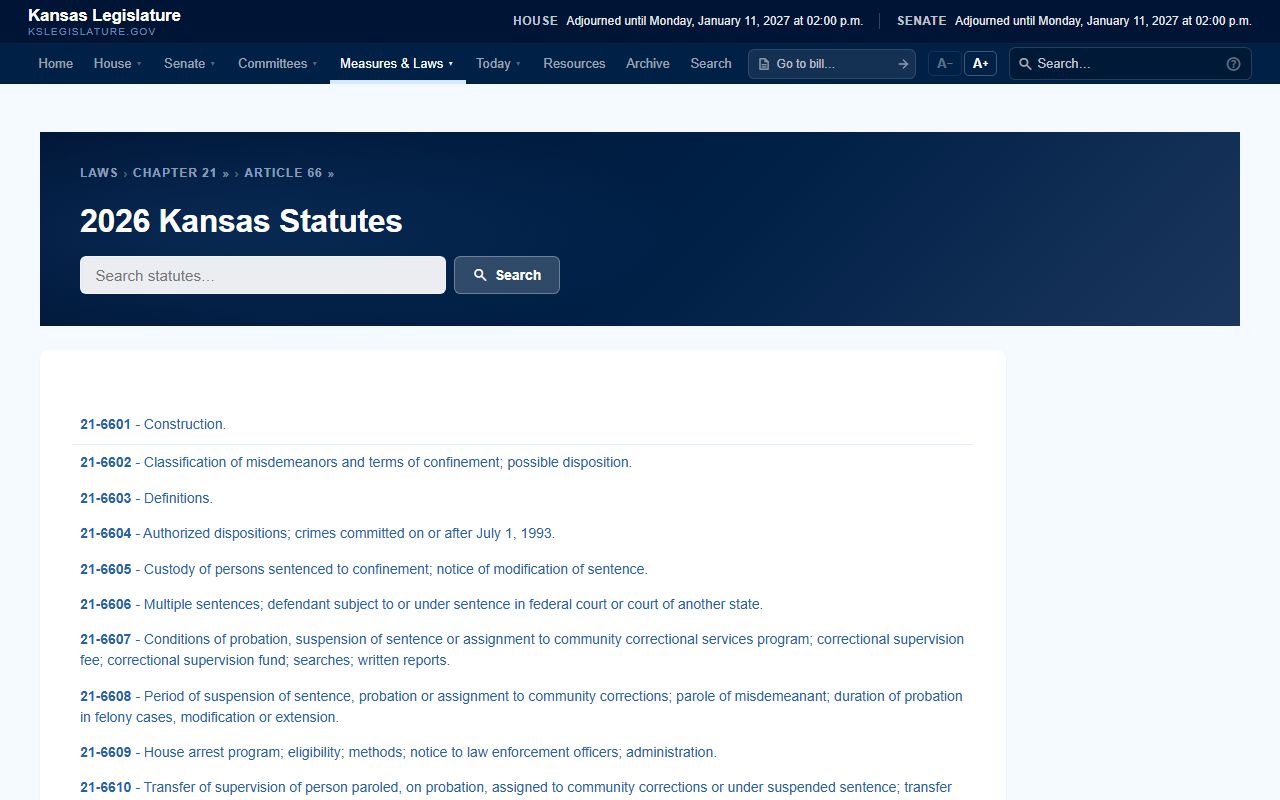
The statute index is useful for criminal court records because expungement changes how a prior conviction, arrest, or diversion may appear to the public.
Restricted Criminal Court Records
Juvenile matters are the clearest restricted category. K.S.A. 38-2309 requires juvenile court official files to be kept separate from other court records and controls disclosure and preservation. Anderson County criminal record searches should not treat juvenile offender records, Child in Need of Care matters, or adoption-related records as freely searchable adult criminal files.
Other restrictions can apply to sealed records, expunged records, active investigative material, mental health or involuntary commitment records, protected-party information, and sensitive personal identifiers. The Anderson County Attorney prosecutes involuntary commitments, but those matters involve medical or mental health facts and should be treated as restricted unless a statute or court order allows release. If a criminal record appears incomplete, the gap may be caused by lawful redaction rather than a search error.
The juvenile records source is K.S.A. 38-2309.
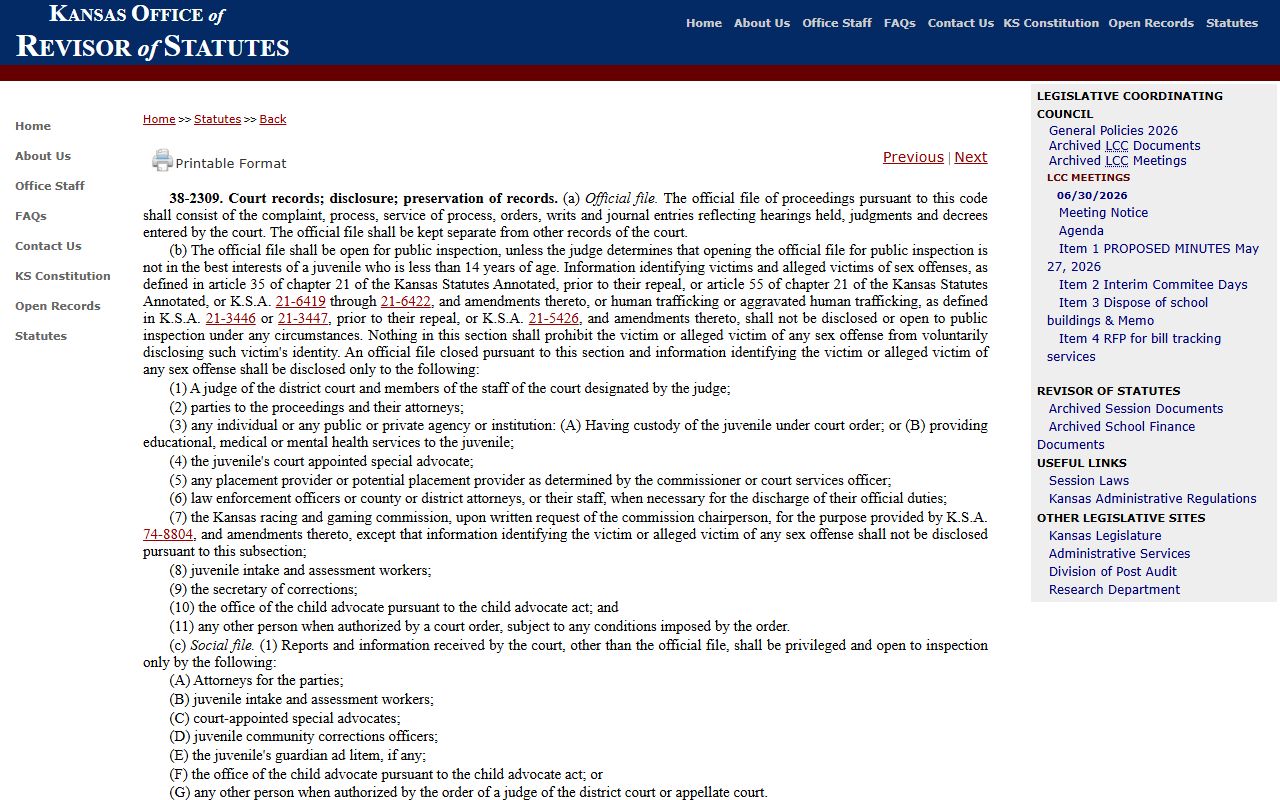
This juvenile file source is the main reason adult criminal court record access rules should not be applied to juvenile case files.
Anderson County Criminal Copies
For certified criminal dispositions, sentencing orders, or docket sheets, contact the Clerk of the District Court at the Anderson County Courthouse. The 4th Judicial District Anderson County page lists the courthouse at 100 E. 4th, Garnett, KS 66032, and provides the district court phone number, (785) 448-6886. District court hours are Monday through Friday, 8 a.m. to noon and 1 p.m. to 4 p.m.
Requesters should provide the case number if known, the defendant's full name, approximate filing year, charge type, and whether the request is for a certified disposition, sentence, docket sheet, or document copy. If the matter belongs in municipal court, contact Garnett Municipal Court instead. If the goal is a statewide criminal history rather than a court file, use the KBI channel and understand that it is not the same record as the Anderson County court case file.