
Anderson County Probate Division
Probate in Anderson County is filed in the Probate Division or probate functions of Anderson County District Court. Kansas district courts have general original jurisdiction and handle probate, estate administration, guardianships, and conservatorships. The local 4th Judicial District Anderson County page is important because it explicitly includes "Old Marriage and Probate Records," which makes older probate files a named local record category rather than a generic statewide topic.
The local court contact is the Clerk of the District Court. Tina Miller is listed as Clerk of the District Court for Anderson County, with the district court at the Anderson County Courthouse in Garnett. Probate users may need Kansas Case Search for public case information, a courthouse terminal for older or non-online files, or direct clerk contact for certified copies and historical records. If the record involves a guardianship, conservatorship, medical detail, minor, or protected financial information, redactions or access limits may apply.
Probate Division of the District Court
Anderson County District Court
100 E. 4th, Garnett, KS 66032
P.O. Box 305, Garnett, KS 66032
(785) 448-6886
Fax: (785) 448-3230
Monday-Friday 8 a.m.-12 p.m. and 1 p.m.-4 p.m.
Anderson County Probate Terms
Probate filings use terms that can be hard to read when searching a case caption or old docket entry. The core words below help separate estate cases from guardianship or conservatorship matters.
- Testator
- A person who made a will.
- Executor
- A person named in a will to carry out estate duties after court appointment.
- Intestate
- A death without a valid will, so estate administration follows Kansas law and court orders.
- Guardianship
- A case about personal care or decision-making for a minor or adult who needs court protection.
- Conservatorship
- A case about managing money or property for a protected person.
- Letters
- Court papers that show authority to act as executor, administrator, guardian, or conservator.
Anderson County Estate Records
Probate records can cover several case types. A decedent estate may include a petition, a will, death proof references, heirs or devisees, an order appointing an executor or administrator, letters testamentary or administration, bond, inventory, creditor notice, claims, sale or transfer orders, accounting, and final settlement. A will case can focus on admitting the will and appointing the personal representative. An intestate estate starts without a will and uses Kansas law to identify heirs and administration steps.
Guardianship and conservatorship cases are also probate-related district court matters. They can include reports, accountings, medical or financial detail, and minor or vulnerable-adult information. Those files are more likely to include restricted or redacted material. Trust-related petitions, determinations of descent, ancillary probate for out-of-state property, and small-estate procedures may also appear when Kansas law permits the selected process.
The Kansas Self-Help filing court papers page explains general district court filing channels.
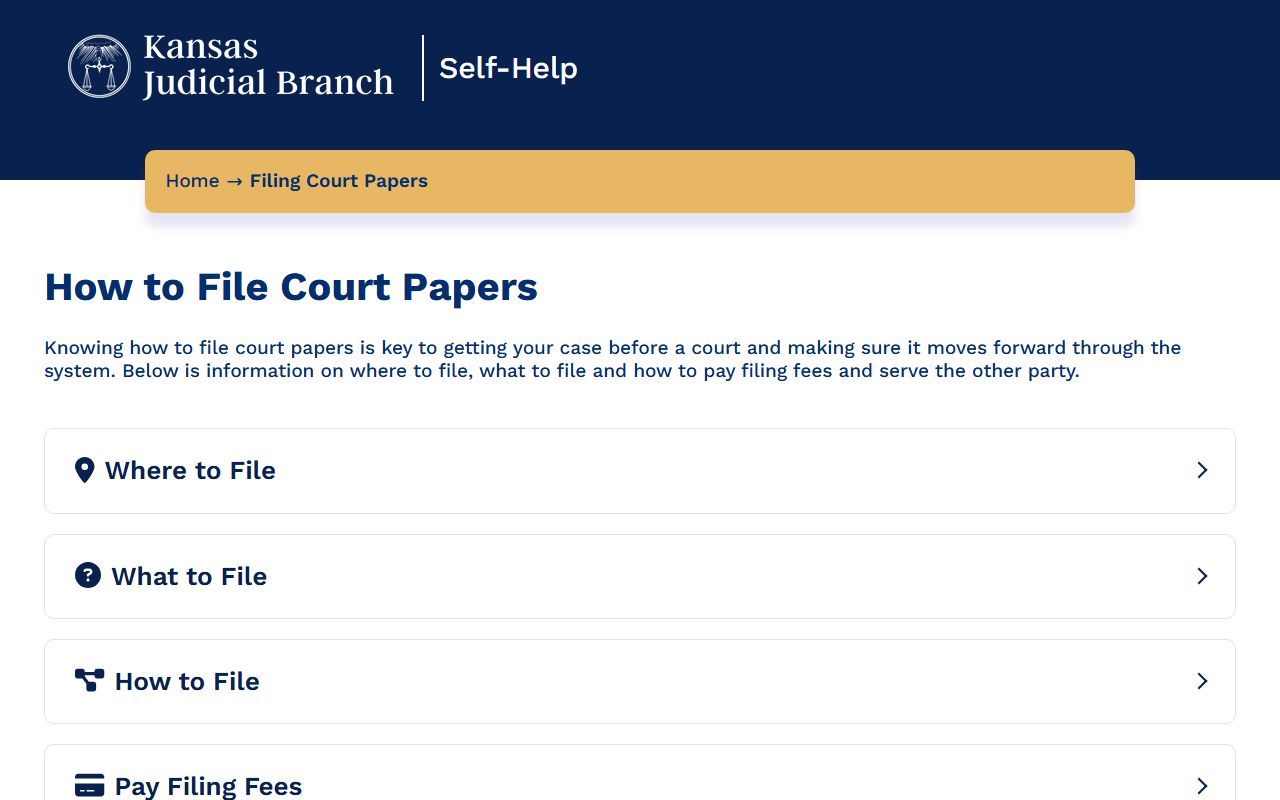
That statewide filing source is useful for the mechanics of court filing, while probate-specific pleadings may require legal advice or court forms.
Search Anderson County Probate Records
Start with Kansas Case Search when the goal is public probate case information. Use the courthouse public terminal or clerk contact when the file is older, not available online, needs certified copies, or relates to the old probate records referenced by the 4th Judicial District Anderson County page. A probate caption may be under the estate name, decedent name, ward name, guardian name, or conservator name, depending on the case type and what information is public.
Historical probate searches need more context than modern case lookups. Provide the decedent or ward name, an approximate year, family names if known, and whether the request is for a will, inventory, letters, final settlement, or a docket entry. Older Anderson County probate records may require clerk assistance because not every record is represented in the statewide online case index.
- Identify whether the matter is a decedent estate, will, guardianship, conservatorship, trust petition, or determination of descent.
- Search Kansas Case Search by estate, party, or case number when available.
- Use the Anderson County courthouse terminal for older or non-online files.
- Contact the Clerk of the District Court for certified copies, historical probate records, or file access questions.
- If real estate was transferred, check the Register of Deeds for recorded deeds or related instruments.
| Field Label | Type | Required | Notes |
|---|---|---|---|
| Party / Estate Name | Text | Conditional | Search decedent name, estate caption, guardian name, or ward name if public. |
| Case Number | Text | Conditional | Use a known probate case number. |
| Case Type | Dropdown/filter | Optional | Probate, guardianship, or conservatorship if the portal exposes type filters. |
| County | Dropdown/filter | Optional | Select Anderson County if a county filter is available. |
| Date Range | Date | Optional | Use filing dates to narrow historical cases. |
Probate and Land Records
The Anderson County Register of Deeds is a separate office from the district court. Probate files are court records. Deeds, mortgages, easements, surveys, oil and gas leases, assignments, releases, tax liens, UCCs, and other recorded land instruments are Register of Deeds records. When an estate order results in a deed or real estate transfer, the court order and the recorded land document may both matter, but they answer different questions and come from different custodians.
For the court authority to sell, transfer, or distribute property, search the probate file through the district court. For the recorded deed, chain of title, or public land instrument, use the Register of Deeds. The research names Sandra J. Baugher as Register of Deeds and lists the office in the courthouse, with public hours Monday-Friday 8:00 a.m.-5:00 p.m.
Anderson County Register of Deeds
100 East Fourth Avenue
Garnett, KS 66032
785-448-3715
regofdeeds@andersoncountyks.org
Monday-Friday 8:00 a.m.-5:00 p.m.
The Anderson County Register of Deeds page documents the county land-record office.
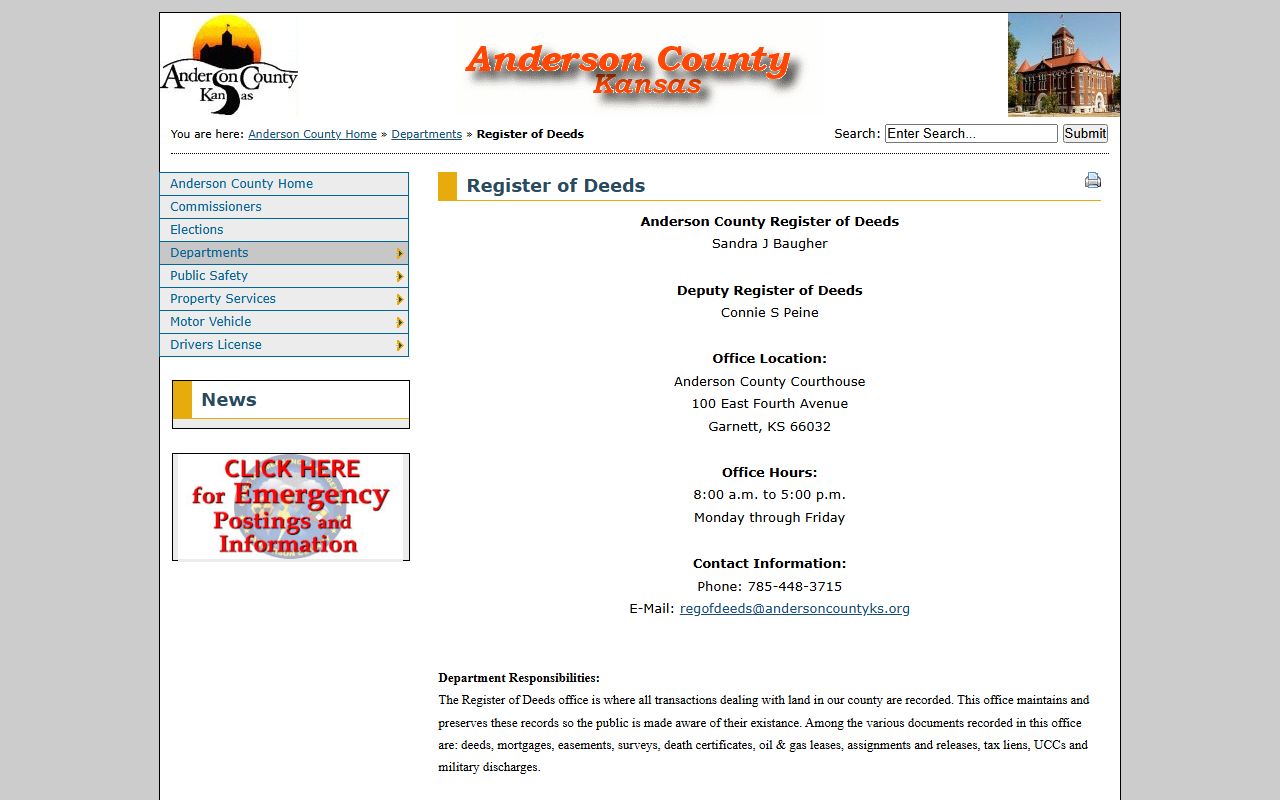
This office is relevant when a probate estate changes land records, but it is not the custodian of the probate court case file.
Anderson County Probate File Contents
A public probate file may show the petition or application, death proof references, will and codicils if filed, heir or devisee list, order appointing an executor or administrator, letters, bond, inventory and valuation, creditor notices, claims, sale or transfer orders, accounting, and final settlement. The exact set depends on case type and case age. A guardianship or conservatorship file can include reports, accountings, medical facts, protected financial facts, and information about minors or adults who need protection.
Older files may not be fully represented online. That is why the 4th Judicial District's reference to old marriage and probate records is useful. Search online first for a modern case, then use the clerk or terminal path when the matter is historical, missing online, or document-level access is needed.
Anderson County Probate Fees
Official Anderson County sources did not publish a local probate copy and certification fee schedule during the research pass. Kansas Self-Help publishes district court filing fees, and K.S.A. 45-219 allows reasonable public-record fees and costs. Probate filing fees can vary by case type and filing, so confirm the current amount with the Clerk of the District Court before filing or requesting certified copies.
| Item | Amount / Status |
|---|---|
| Probate filing fee | Varies by case type; use Kansas Self-Help district court fee framework. |
| Guardianship or conservatorship filing | Varies by case type; confirm with the Clerk of the District Court. |
| Plain probate copy | Local amount not located in official Anderson County sources. |
| Certified probate copy or letters | Local amount not located in official Anderson County sources. |
| Public-record copy costs | Reasonable fees and costs are allowed under K.S.A. 45-219. |
The K.S.A. 45-219 public records fee source addresses copy fees and access costs.
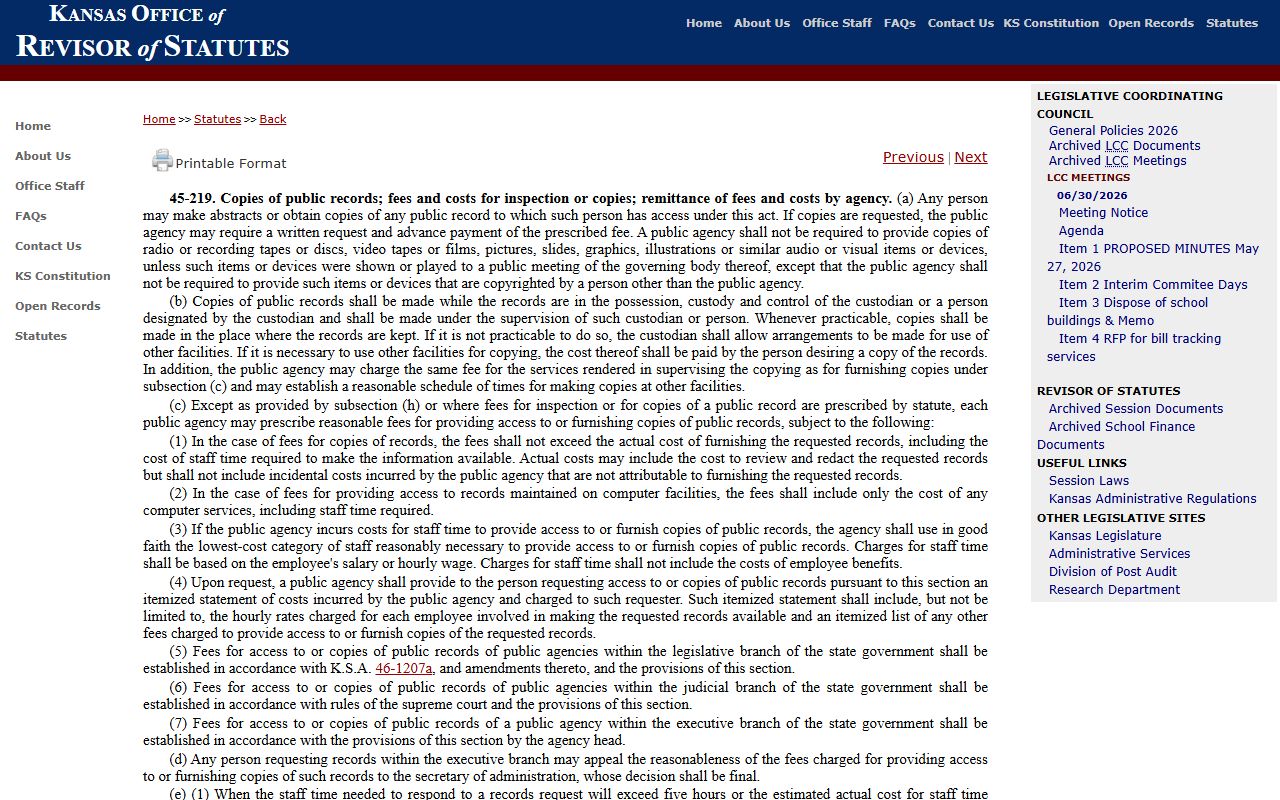
That statute supports asking the clerk for current costs before ordering probate copies or certified papers.
Restricted Anderson County Probate Records
Not every probate-related record is fully public. Guardianship and conservatorship records can contain medical, financial, and minor information. Mental health or protective details may be restricted. A probate file may also include Social Security numbers, financial account numbers, protected addresses, or other data that must be redacted before public access. Kansas public access law favors open records unless another law limits disclosure, but K.S.A. 45-221 and court rules allow some information to be withheld or separated from open material.
Access can also vary by document within the same case. A public docket or order may be available while a medical exhibit, minor's report, financial account detail, or sealed filing is withheld. If a requester has a legal role in the estate, guardianship, or conservatorship, the clerk may need that role stated before explaining what copy options are available.
Requesters should be clear about whether they need a docket entry, a plain copy, certified letters, a will, an inventory, a final settlement, or a land-transfer document. That detail helps the clerk or Register of Deeds route the request to the right record source.
Note: Court probate files and Register of Deeds land records can relate to the same estate, but they are not the same record.